
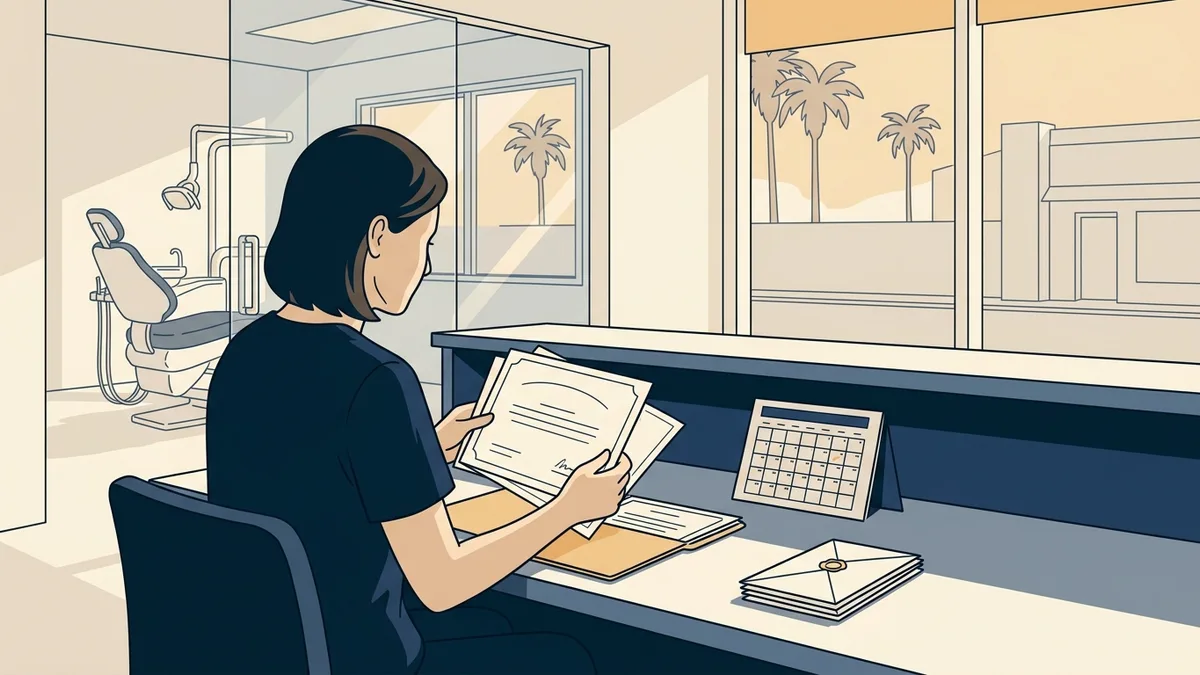
Dentists licensed in another state can apply to the Dental Board of California by credential under Business and Professions Code section 1635.5. You need a current unrestricted license, 5,000 hours of recent clinical practice, 50 CE units from the last two years, NPDB and DEA releases, and a sworn acknowledgment. The application fee is $525.
California runs dental licensing through two separate boards. The Dental Board of California licenses dentists, and the Dental Hygiene Board of California handles hygienists. For a dentist, the Dental Board of California lists four ways in: an application after passing the WREB examination, an application after passing the ADEX examination, licensure by credential for dentists who already hold a license in another state, and licensure by residency. A special permit route also exists for faculty at a California dental school.
Which route fits depends on where you are in your career. A recent graduate usually comes in through ADEX, WREB or a residency. A dentist with years of practice elsewhere usually looks at licensure by credential. The two have very different paperwork, and the credential route has a sworn acknowledgment at its center.
Which routes into a California dental license exist?
- ADEX or WREB examination. The ADEX route is authorized by Business and Professions Code section 1632(c)(2) and 16 CCR section 1028, according to the Board's licensure-by-ADEX page. The Board wants ADEX results from within the five years before you apply, covering the computer-based DSE OSCE plus prosthodontic, endodontic, restorative and periodontal scaling sections. The Board has posted a notice on its acceptance of manikin-based WREB and ADEX examinations.
- Licensure by residency. On February 1, 2008, the Office of Administrative Law approved the Board's emergency regulations implementing SB 683. That route rests on "completion of a minimum of 12 months of a general practice residency or advanced education in general dentistry program" approved by the Commission on Dental Accreditation (CODA).
- Licensure by credential. For dentists with a current license in another state, under Business and Professions Code section 1635.5. The sections below focus on it.
- Special permit. A narrow permit that lets a recognized specialist practice at the California dental college that employs them and its affiliated institutions.
For how ADEX acceptance differs across states, see ADEX and which clinical exams each state accepts. For the residency route in general, see the PGY-1 residency route to a dental license.
What does licensure by credential require?
Section 1635.5 lets the Board license a dentist "who has not taken an examination before the board" if the applicant submits all of the following:
- A completed application and all fees.
- Proof of a current license from another state "that is not revoked or suspended or otherwise restricted."
- Proof of active clinical practice, or full-time faculty work in an accredited dental education program combined with active clinical practice, "for a total of at least 5,000 hours in five of the seven consecutive years immediately preceding" the application.
- Proof that you have not been disciplined by any state where you hold or held a license. If you have been, the Board reviews the action and may ask for more information or deny the application.
- A signed release allowing disclosure of information from the National Practitioner Data Bank and verification of your registration with the federal Drug Enforcement Administration.
- Proof that you have not failed California's licensing examination within the five years before applying.
- An acknowledgment "executed under penalty of perjury and automatic forfeiture of license" that the information you provided is true and correct and that you have not been convicted of certain offenses.
- Documentation of 50 units of continuing education completed within two years of the application, including the mandatory coursework the Board prescribes.
The Board's current pathway page describes the clinical requirement as at least 5,000 hours within the five years immediately preceding the application. The statute counts it over five of the seven years before you apply. If your practice history has a gap, read both and ask the Board which window it will apply to your file before you submit.
Can residency or teaching count toward the 5,000 hours?
Yes, within limits. The statute gives three alternatives:
- A CODA-accredited residency, such as a general practice residency, an AEGD program or a specialty program, can earn credit for two of the five years.
- You can agree to practice full time for two years in a qualifying primary care clinic or a clinic run by a public hospital or health system. The Board may check compliance and may revoke the license if the commitment is not met.
- You can agree to teach or practice full time for two years in an accredited dental education program approved by the Board, with the same compliance checks.
The Board's credential pages split these into separate pathways (clinical practice, clinical practice with residency completion, a pending clinical practice contract, a pending faculty practice contract and non-clinical practice), each with its own forms. Solo practitioners submit two verification forms, LBC 3(a) and LBC 3(c), to prove their hours.
How does the Board want the paperwork delivered?
California is strict about who sends what, and most delays come from documents arriving the wrong way:
- Out-of-state license certification. The Board accepts an electronic copy only if it is emailed directly from the other licensing agency. It "will not accept license verifications directly from the applicant, whether via BreEZe, email, or mail (unless delivered in a sealed unopened envelope)."
- Certification of Non-Failure of Licensure. Required even if you have never taken WREB, ADEX or another state, regional or national licensure exam.
- Fingerprints. Live Scan is only available in California. Board staff email Live Scan forms after you apply; applicants outside California use hard cards and pay a $49 processing fee.
- The CE packet. All 50 courses must be complete before you send anything. The Board wants the packet emailed in its entirety with a CE Tracker form and every certificate attached, not uploaded into BreEZe. Transcripts are not accepted in place of certificates, and courses "focused on office or practice management will not be accepted."
- BLS. The BLS course must include a live, in-person skills session; online-only BLS does not count. The Board awards at most 4 units for it, and mandatory courses together count for up to 10 units.
How much does a California license cost?
The Board's fee schedule is set in 16 CCR section 1021:
- Licensure by credential application: $525
- Application after ADEX or WREB (section 1632(c)): $400
- Law and Ethics Examination application: $125
- Initial license: $650, prorated by birth date
- Biennial license renewal: $650
- Additional office permit: $350
The ADEX route page lists the Law and Ethics Examination as a step for exam applicants, and notes the license will not be issued until fingerprint clearance is complete. See dental jurisprudence and law exams by state for how California's exam compares, and what dental license fees look like across states for context.
Are sedation and specialty permits separate?
Yes. A California license does not include any sedation or surgical permit. The same fee rule lists each one separately:
- General anesthesia or moderate sedation permit application: $524, plus an on-site inspection and evaluation fee of $2,000
- Pediatric minimal sedation permit: $459
- Use of oral conscious sedation on adult patients: $459
- Pediatric endorsement for a general anesthesia or moderate sedation permit: $532
- Oral and maxillofacial surgery permit: $500
- Elective facial cosmetic surgery permit: $850
- Special permit: $1,000
If you hold a sedation permit in another state, plan for a new California application and an inspection. Moving your sedation permit to a new state covers what usually carries over and what does not.
Where do hygienists and the dental compact fit?
Hygienists apply to the Dental Hygiene Board of California, not the Dental Board. California has its own rules for out-of-state hygienists, covered in California's requirements for out-of-state hygienists.
California has not joined the Dentist and Dental Hygienist Compact, and the compact is not issuing privileges anywhere yet. A California license comes only through one of the routes above. The dental compact hub tracks the compact's status.
Where do we fit into a California application?
Our Dentist License by Credentials service is $799 for California. We map your practice hours against the 5,000-hour test, pick the right pathway form, order your out-of-state certifications so they arrive directly from each board, build the CE Tracker, and give you a question-by-question guide to the application. You review every answer, sign the penalty-of-perjury acknowledgment, pay the Board and submit through BreEZe from your own account. If you are coming in through ADEX or a residency instead, the Full State Dental License Application is $899. Sedation permits are $699 each. Board, exam and fingerprint fees are separate. Not sure you qualify? Start with the $149 Dental Licensure Readiness Review, or see the California requirements page.
Common questions
- Does California accept ADEX for a dental license?
- Yes. The Dental Board of California lists an application after passing the ADEX examination as one of its licensure routes, with results from within the five years before you apply. WREB, a 12-month CODA-accredited GPR or AEGD residency, and licensure by credential are the other routes.
- How many hours do I need for California licensure by credential?
- Section 1635.5 requires at least 5,000 hours of active clinical practice, or faculty work plus clinical practice, in five of the seven consecutive years before you apply. A CODA-accredited residency can count for two of the five years.
- Can I upload my CE certificates to BreEZe?
- No. The Board asks credential applicants to email the full CE packet, with a CE Tracker form and every certificate, only once all 50 courses are complete. It does not accept CE uploaded into BreEZe or transcripts in place of certificates.
- Does my sedation permit transfer to California?
- No. California issues its own general anesthesia, moderate sedation, pediatric minimal sedation and adult oral conscious sedation permits, each with a separate application fee. A general anesthesia or moderate sedation permit also carries a $2,000 on-site inspection fee.
Need Help with Your Application?
We prepare the dental licensing process end-to-end — eligibility screening, documents, board follow-ups, and tracking.