
ADEX is accepted or required for initial dental licensure in nearly every US jurisdiction, but the ADEX map lists two exceptions: Delaware, which requires its own practical exam, and New York, which requires a one-year residency. CRDTS is accepted in over 40 states. Texas, Virginia and others also check which exam your original license followed.
Every dental license rests on three pillars, according to the ADA: an educational requirement, a written exam and a clinical assessment. The written part is uniform, since every US jurisdiction requires the INBDE. The clinical part is not. "Most state boards of dentistry rely on third-party testing agencies to administer a clinical assessment," the ADA says, "and acceptance varies by state and territory."
For a new graduate, that variation decides which exam to sit. For an experienced dentist moving states, it decides whether the exam taken years ago still counts. Here is how the landscape looks as of October 2026.
Who gives the clinical exams now?
The old map of regional boards (NERB, CDCA, WREB, CITA, SRTA, CRDTS) has consolidated. Two agencies now give most clinical licensure exams:
- ADEX, the American Board of Dental Examiners. In its April 2026 announcement with the ADA, ADEX described its exams as "accepted or required by law in 51 U.S. jurisdictions" and said they "serve as the initial licensure pathway for 98% of dental and 85% of dental hygiene candidates nationwide."
- CRDTS, the Central Regional Dental Testing Service. CRDTS says its exams "are recognized and accepted in over 40 states." Its map separates states that accept CRDTS for initial licensure from states that accept it only "via Credentialing." The Texas board refers to scores from "CRDTS-SRTA."
Dentists licensed years ago may hold results from agencies that no longer test under their old names. Many statutes still list them. Ohio's law, for example, names CRDTS, NERB, CDCA, SRTA, CITA and WREB (Ohio Rev. Code 4715.10(D)). Pennsylvania's board lists ADEX, CDCA, CRDTS, CITA, SRTA and WREB.
What does the ADEX dental exam include now?
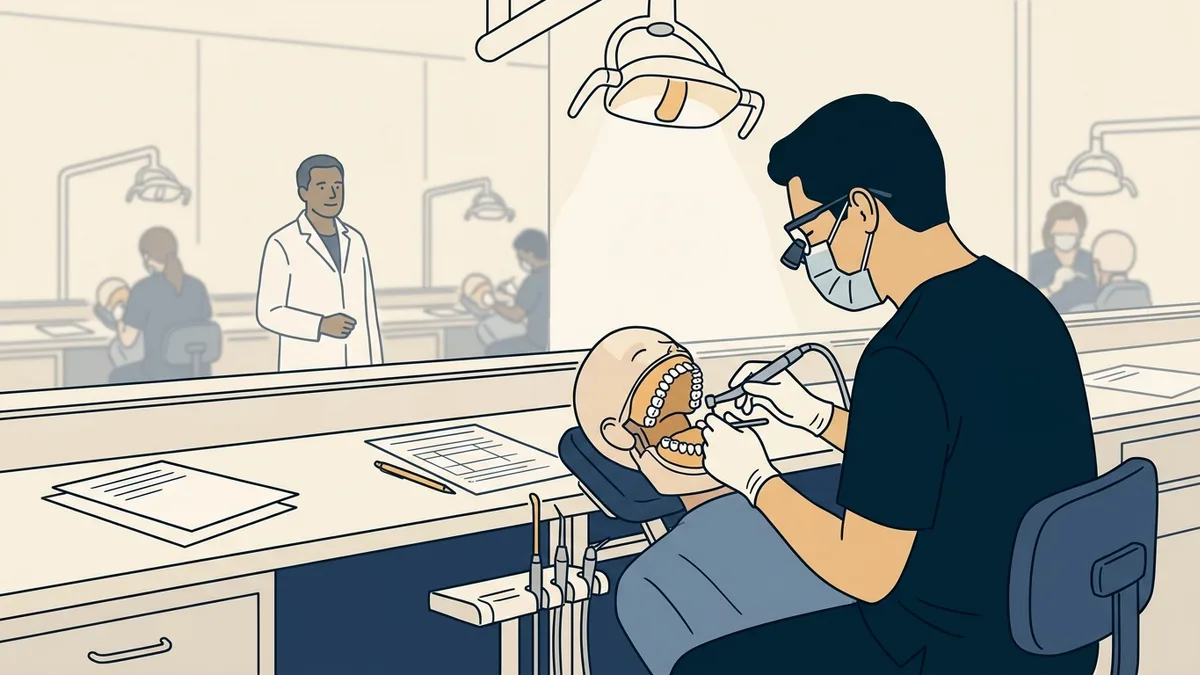
According to ADEX, the Dental Examination series has candidates "challenge five hand-skill components and the ADA's Dental Licensure OSCE (DLOSCE)." The clinical parts are performed "on simulated patient manikins": periodontal, endodontic, prosthodontic, anterior restorative and posterior restorative. ADEX notes that "effective August 1, 2026, the Periodontal Examination will be a required component."
The computer-based part changed in 2026. ADEX agreed to sunset its own DSE OSCE and include the DLOSCE in every ADEX dental administration, and the standalone DLOSCE is ending. See the DLOSCE folds into ADEX.
Fees, per ADEX: $2,995 for the series plus a facility fee that varies by location, with one complimentary retake per clinical procedure and a $150 typodont fee per procedure.
Which states do not accept ADEX for initial licensure?
Two. The ADEX acceptance map, updated September 9, 2026, says jurisdictions "not accepting the ADEX Dental Examination for initial licensure are depicted in grey and include Delaware and New York." A separate hygiene map notes that "Delaware does not accept the ADEX Dental Hygiene Examination for initial licensure."
- New York has required a one-year approved residency for initial licensure since January 1, 2007, and says a clinical exam "such as NERB will not be accepted for initial licensure after December 31, 2006." See the PGY-1 residency route.
- Delaware requires its own practical exam, prepared and administered by its Board (24 Del. C. §1123), plus a residency year.
So ADEX works for initial licensure in most places, and not everywhere. Anyone who says otherwise is wrong about two jurisdictions with a lot of dentists between them.
How do individual states treat exams?
A few examples show the range:
- Florida requires ADEX by statute for its standard license. Scores from ADEX taken outside Florida count if completed on or after October 2, 2011. See getting a Florida dental license.
- California accepts WREB or ADEX. For ADEX, the Dental Board of California asks for passing results within five years before the application on the DSE OSCE, restorative and periodontal scaling sections. It also licenses through a 12-month residency and through credentials. See getting a California dental license.
- Texas says it currently validates scores from ADEX and CRDTS-SRTA, wants the exam within seven years for licensure by exam, and requires the periodontics and prosthodontics sections for exams taken after January 1, 2019 (Rule 101.2(e)). The Board notes it accepted results based on what agencies offered during the pandemic.
- Nevada accepts a clinical exam approved by its Board and ADEX, or a WREB certificate (NRS 631.240).
- Ohio accepts any of the listed agencies, an exam given by its own board, or completion of a CODA-accredited residency (Ohio Rev. Code 4715.10(D)).
- Virginia lists acceptable exams in its Guidance Document 60-25.
Does your original exam matter after years of practice?
Often, yes. Licensure by credentials skips a new exam, but some states still look at the first one:
- Texas requires that your other-state license "followed a successful completion of a general dentistry clinical examination administered by another state or regional examining board."
- Virginia requires a clinical competency exam acceptable under its guidance document.
- Connecticut asks for a license "issued after examination" with standards commensurate with its own "except for the practical examination."
- Florida asks experienced dentists with older out-of-state ADEX scores for five years of full-time practice proof.
The dentists most at risk are those licensed through a residency or an OSCE-only pathway, and those whose exam lacked a section a state now requires. Check before you sign a contract. More in dental license by credentials.
What should you gather if your exam is years old?
Dentists licensed a decade or more ago often have to prove an exam they barely remember. Before you apply anywhere that looks at the original exam, collect:
- The agency and year. NERB, CDCA, WREB, CITA, SRTA, CRDTS or ADEX, and the date of each part.
- The sections you passed. Texas asks about periodontics and prosthodontics for exams after January 1, 2019. California's ADEX route lists the DSE OSCE, restorative and periodontal scaling sections by name.
- Whether patients or manikins were used. ADEX now tests on manikins; older exams often used live patients. A board comparing exams may ask.
- An official score report from the agency. Texas says it validates ADEX and CRDTS-SRTA scores electronically and that mailed score reports "must remain in the original sealed envelope." California says applicants can ask the testing agency to send scores electronically.
- Any failed attempts. California's residency route asks you to certify that you have not failed a state, regional or national licensure exam within five years, unless you later passed it.
With that in hand, most exam questions on a credentials application become simple. Without it, they become letters back and forth with a testing agency that may have changed its name since you sat the exam.
Are hygienists treated the same way?
Hygienists have parallel options. ADEX and CRDTS both give dental hygiene exams, with Delaware the stated exception for ADEX hygiene. The JCNDE launched the Dental Hygiene Licensure OSCE (DHLOSCE) in 2025 and says some states now accept it in fulfillment of their clinical exam requirement; the JCNDE's state list is the place to check. ADEX and CRDTS each tell candidates to confirm acceptance with the state board, and we agree. See hygienist license by credentials.
Where should you check before registering?
Both agencies put the burden on you. ADEX's licensure disclaimer says "The onus is on the Candidate to ensure that all requirements for licensure are met in a given state." CRDTS says it is "the responsibility of the applying candidate to confirm acceptance." Read the target board's page, then confirm in writing if anything is unclear.
Our $149 Dental Licensure Readiness Review does that check for you: we pull your exam history, compare it against each target state's current rules, and tell you which states will accept it, which need more, and which need a new exam. You take every exam yourself; we never sit an exam for anyone. If a new license follows, the Full State Dental License Application ($899 per state) or Dentist License by Credentials ($799 per state) service prepares the file, and you complete, sign and submit it. See each state on the state license index.
Common questions
- Does every state take ADEX for a first license?
- No. The ADEX map says Delaware and New York do not accept the ADEX Dental Examination for initial licensure, and Delaware does not accept the ADEX Dental Hygiene Examination either.
- Will my old WREB or NERB exam still count?
- Often, but not always. Many statutes still list legacy agencies, and California accepts WREB. States that look at the original exam during licensure by credentials, such as Texas and Virginia, apply their own standards, so check the specific board.
- Is the ADEX dental exam done on live patients?
- ADEX says its clinical exams are performed on simulated patient manikins, alongside the computer-based DLOSCE. The periodontal exam became a required component effective August 1, 2026.
- Can a residency replace the clinical exam?
- In some states. New York requires a one-year residency for initial licensure, California licenses through a 12-month GPR or AEGD, and Ohio accepts a CODA-accredited residency. Texas does not accept a GPR or AEGD in place of a regional exam for foreign-trained graduates.
Need Help with Your Application?
We prepare the dental licensing process end-to-end — eligibility screening, documents, board follow-ups, and tracking.