
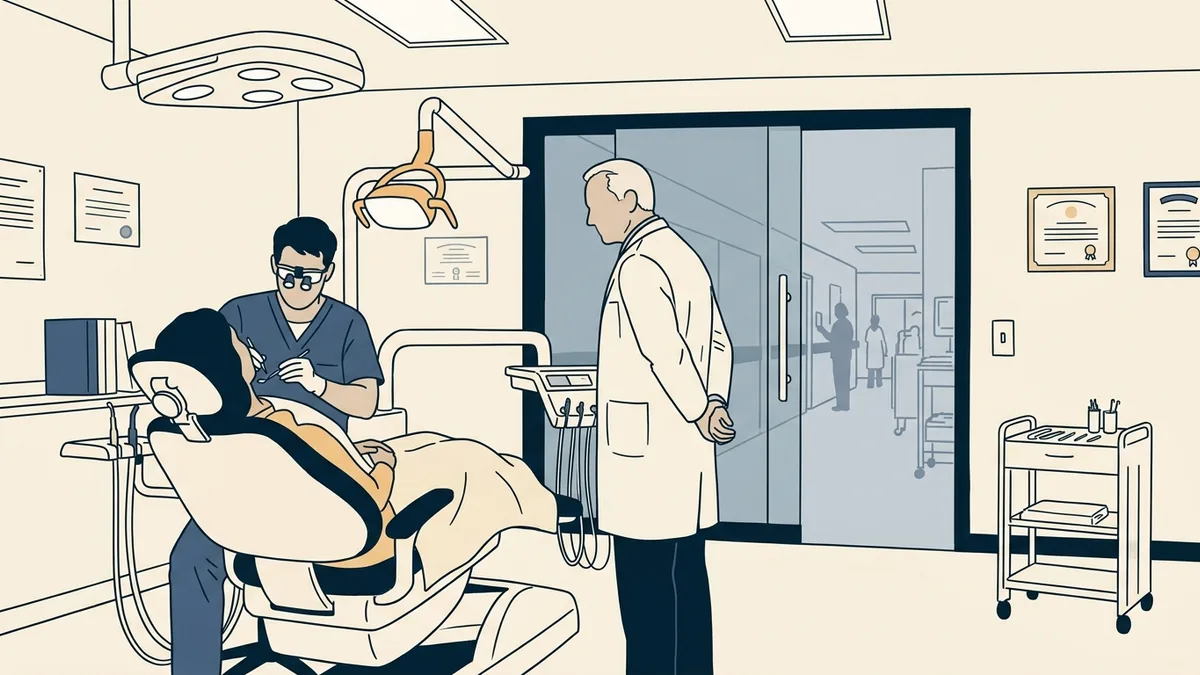
Some states accept a one-year accredited general practice residency or AEGD program in place of a clinical licensure exam. New York requires it for initial licensure, California offers Licensure by Residency, and Ohio's statute accepts a CODA-accredited residency. The catch: states such as Texas and Connecticut ask whether your original license followed an exam.
Most new dentists earn their first license by passing a clinical exam such as ADEX. A second route skips the exam: complete a postgraduate year (often called PGY-1) in an accredited general practice residency (GPR) or advanced education in general dentistry (AEGD) program, and some states will accept that year as your clinical assessment. One state, New York, requires it.
The residency route has real advantages, and one long-term catch that matters if you ever move. Here is how it works in the states we see most.
Which states accept a residency instead of a clinical exam?
- New York requires it. "Beginning January 1, 2007, all applicants for initial licensure must complete an approved dental residency program of at least one year's duration," according to the NYSED Office of the Professions. The Department must receive verification "directly from the residency program director." A clinical exam "such as NERB will not be accepted for initial licensure after December 31, 2006."
- California offers Licensure by Residency under SB 683, implemented by emergency regulations approved February 1, 2008. The Dental Board of California requires completion of a GPR or AEGD program "at minimum, one year in duration," accredited by CODA or a Board-approved national accrediting body, completed "within two years prior to the date of their application." The application processing fee is $800.
- Ohio accepts completion of "a dental residency program accredited or approved by the commission on dental accreditation and administered by an accredited dental college or hospital" as one way to meet its clinical requirement (Ohio Rev. Code 4715.10(D)(3)).
Delaware is different. It requires a GPR year or a CODA-approved specialty residency for initial licensure, and it also requires its own practical exam (24 Del. C. §1122(a)). There, the residency is an extra requirement, not a substitute.
What does a residency-route application involve?
California's Licensure by Residency checklist is a good example of the paperwork:
- Proof of graduation from a CODA-accredited or Board-approved dental school, sent by the school or on the dean's certification form.
- Proof of passing the National Board written exam.
- A Certification of Clinical Residency Completion, completed after you finish and bearing the program's educational seal, or a signed letter from the program director if the program has no seal.
- A Certification of Non-Failure: proof that you have not failed a state, regional or national licensure exam within five years before applying. If you failed and later passed, the earlier failure does not disqualify you. The Board requires this form "even if you have never taken the WREB or ADEX examination."
- Fingerprints, by Live Scan (available only in California) or on hard cards.
- California's Law and Ethics exam, which has its own $125 application fee.
New York adds its own mandated courses in child abuse identification and reporting and in infection control, plus education verification on Form 2. Residents in New York programs must hold a limited permit ($105, valid one year and renewable annually while the residency continues).
Why does the residency route matter when you move?
A residency-based license is a full license. The issue comes later, when a dentist applies elsewhere through licensure by credentials and the new state asks what the original license rested on:
- Texas requires that your out-of-state license "followed a successful completion of a general dentistry clinical examination administered by another state or regional examining board." A license that followed a residency instead of an exam may not meet that wording. Texas also says, for foreign-trained graduates, that it "will not recognize" a GPR or AEGD "in lieu of completing a Regional Clinical Examination."
- Connecticut licenses without exam a dentist whose license was "issued after examination by another state."
- Florida requires ADEX for its standard license regardless of practice history, so a residency-licensed dentist would sit ADEX.
- Virginia requires an acceptable clinical competency exam under its Guidance Document 60-25.
We are not saying these states always refuse residency-licensed dentists. We are saying the question will come up, and the answer depends on the exact rule and sometimes on a board's judgment. Before committing to a job in another state, have the original pathway checked against that state's current wording. See dental license by credentials.
Does the dental compact count a residency?
The compact FAQ says its clinical assessment requirement "includes all pathways accepted by a participating state such hands-based skills assessments, the DLOSCE, and PGY-1 dental residency programs." The Commission's draft rule would count "dental residency experience." Some commissioners pushed in 2026 for a mandatory hands-on exam, and the rule was still unresolved in the Commission's posted records. The compact issues no privileges yet in any case. See why the dental compact is not issuing privileges yet.
Is the residency route right for you?
If you are headed to New York, it is the route. If you want California or Ohio and a residency fits your training plans, it avoids a clinical exam. If you might later practice in Texas, Florida or Connecticut, weigh whether also passing ADEX now would save you an exam, or a dispute, later. Our post on your first dental license as a new graduate walks through the choice.
Our $149 Dental Licensure Readiness Review maps your residency and exam history against the states you might want, now and later. For the license itself, our Full State Dental License Application service ($899 per state) prepares the residency certification, transcripts, score reports, fingerprint scheduling and a question-by-question guide, and tracks the board. You complete, sign and submit the application and take every exam yourself.
Common questions
- Does New York accept ADEX for a first dental license?
- No. New York has required an approved dental residency of at least one year for initial licensure since January 1, 2007, and says a clinical exam such as NERB is not accepted for initial licensure after December 31, 2006.
- How recent must my residency be for California's residency route?
- The Dental Board of California says completion of the GPR or AEGD program must be within two years before the date of your application.
- Can a residency-licensed dentist get licensed by credentials elsewhere?
- Often, but check first. Texas requires that the other-state license followed a general dentistry clinical exam, and Connecticut asks for a license issued after examination. The answer depends on the state's wording and sometimes the board's judgment.
Need Help with Your Application?
We prepare the dental licensing process end-to-end — eligibility screening, documents, board follow-ups, and tracking.