
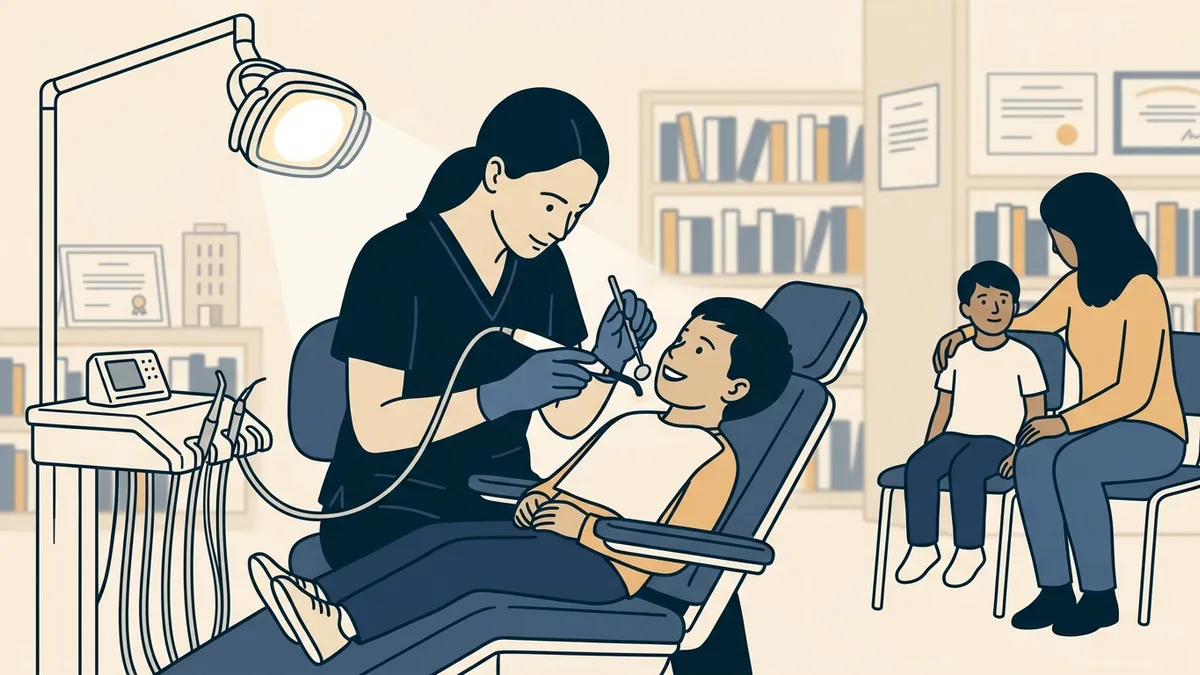
Public health and collaborative practice permits let dental hygienists treat patients in community settings without a dentist present, but each state sets its own rules. Minnesota requires a collaborative agreement with a dentist, Virginia allows remote supervision after 2,500 clinical hours in listed settings, and California issues a separate RDHAP license. Quote the state statute before planning a practice.
Public health and collaborative practice permits let dental hygienists reach patients who rarely see a dentist: children in schools, residents of nursing homes, patients at community clinics. They are also among the least portable credentials in dentistry. Each state writes its own version, with its own experience requirement, agreement, setting list and service list, and a hygienist who practiced this way in one state has to qualify again in the next.
We do not make general statements about what hygienists may do independently. The answer is in each state's statute and rules, so that is what we quote.
What does "direct access" mean?
The American Dental Hygienists' Association defines direct access as "the ability of a dental hygienist to initiate treatment based on their assessment of a patient's needs without the specific authorization of a dentist, treat the patient without the presence of a dentist, and maintain a provider-patient relationship." ADHA publishes a state-by-state Direct Access chart (revised February 2025) summarizing each state's law. ADHA's own disclaimer applies: the chart is informational and not a legal opinion, and you should verify with the state dental board.
How do the states we checked write these permits?
Minnesota: collaborative practice
Minnesota allows a licensed hygienist to be "employed or retained by a health care facility, program, nonprofit organization, or licensed dentist" to perform listed hygiene services "without the patient first being examined by a licensed dentist" if the hygienist has a collaborative agreement with a licensed dentist and has documented a medical emergencies course in each continuing education cycle (Minn. Stat. § 150A.10, subd. 1a). As published by the Revisor, the agreement must cover medically compromised patients, age- and procedure-specific protocols including when a dentist should examine the patient, consent forms, sealant protocols and record keeping; it is signed by the dentist, the hygienist and the facility and reviewed annually. A collaborating dentist may have agreements with no more than four hygienists unless the board authorizes more. The Revisor notes that the 2026 Legislature amended this subdivision, so read the current text before relying on any detail.
Virginia: remote supervision
Virginia lets a hygienist practice under the remote supervision of a dentist who has a practice physically located in Virginia, meaning the dentist is "accessible and available for communication and consultation" but may not have examined the patient and may not be present (Va. Code § 54.1-2722(G)). The hygienist needs a qualifying CE course and at least two years and 2,500 hours of clinical experience, must carry liability insurance acceptable to the dentist, and may practice this way only in listed settings, such as federally qualified health centers, free clinics, long-term care facilities, schools, Head Start and WIC programs. Patients sign a statement that remote supervision "is not a substitute for the need for regular dental examinations." Treatment can continue for 180 days before the dentist must examine the patient or refer for an exam, and local anesthesia and nitrous oxide are not allowed under remote supervision. A separate provision covers hygienists employed by the Virginia Department of Health or Department of Behavioral Health and Developmental Services (§ 54.1-2722(F)).
California: the RDHAP license
California issues a separate license, the Registered Dental Hygienist in Alternative Practice. The Dental Hygiene Board lists eligibility as completion of an RDHAP program, a current RDH license, at least 2,000 clinical practice hours in the preceding 36 months, a bachelor's degree or equivalent units, and acceptance into a phase of a Health Workforce Pilot Project. See our California hygienist guide.
New York: hospital collaborative arrangements
New York's dental hygiene definition allows a hygienist "working for a hospital" to practice under a collaborative arrangement with a licensed dentist who has a formal relationship with the same hospital. The arrangement does not override any rule requiring a dentist's personal supervision, and the hygienist "shall instruct individuals to visit a licensed dentist for comprehensive examination or treatment" (N.Y. Educ. Law § 6606).
Florida: health access settings
Florida lists tasks a licensed hygienist may perform in a "health access setting" (such as Department of Health programs, nonprofit community health centers, Head Start centers, federally qualified health centers and school-based prevention programs) "without the physical presence, prior examination, or authorization of a dentist," including charting, vital signs, case histories, fluoride and sealants, and removing calculus deposits and stains (Fla. Stat. §§ 466.003, 466.024(2)).
Arizona: public agencies and schools
Arizona lets a hygienist employed by, under contract with or volunteering for a public health agency or a school authority perform a screening or assessment and apply sealants and topical fluoride before a dentist's examination (Ariz. Rev. Stat. § 32-1289). Broader community practice runs through an affiliated practice relationship with a dentist (§ 32-1281(I)).
The affiliated practice statute is worth reading in full (A.R.S. § 32-1289.01). The hygienist must hold an active Arizona license and have practiced at least 500 hours in each of the two years before the relationship begins. The written agreement must identify the settings, the services, the standing orders, the conditions for local anesthesia and root planing, and when the hygienist must consult the dentist before further treating a patient who has not seen a dentist within twelve months. Patients are told in writing that the care "does not take the place of a diagnosis or treatment plan by a dentist." Contracts may be made only with listed entities, such as health care organizations, public health agencies and nonprofit or charitable organizations, and the hygienist may not practice in unlisted settings. The hygienist may perform authorized hygiene procedures except diagnostic procedures reserved to dentists and nitrous oxide. A dentist may not have more than six affiliated practice hygienists providing services at any one time, and both must send the board a copy of the agreement within thirty days of its effective date.
Compare that with ADHA's chart, which still summarizes Arizona's eligibility as five years of licensure (or three with a bachelor's degree) plus 500 hours in each of the two prior years and 12 hours of CE. The statute we read lists the 500-hour test and leaves continuing education to board rules. Differences like that are why we quote the statute.
Which other states have programs, according to ADHA?
ADHA's chart summarizes many more programs. A few examples, with the statute ADHA cites, to show how much they differ:
- Illinois (225 ILCS 25/18.1): a public health dental hygienist with 2 years of full-time clinical experience or 4,000 hours and 42 hours of public health coursework, practicing under a written public health supervision agreement, for Medicaid-eligible or low-income uninsured patients.
- Pennsylvania: certified public health dental hygiene practitioners with 3,600 hours of experience, liability insurance, and 5 hours of public health CE each licensure period.
- Oregon (ORS 680.205): the Expanded Practice Dental Hygienist permit, which replaced the limited access permit.
- Kansas (K.S.A. 65-1456): Extended Care Permits I, II and III, with hour requirements from 1,200 to 2,000 and a sponsoring dentist agreement.
Treat these as leads to the statute, not as the law itself.
Before applying, which documents should a hygienist gather?
- Documented clinical hours in the format the state wants, often certified by a supervising dentist.
- Required coursework, such as Minnesota's medical emergencies course or Virginia's remote supervision course.
- The agreement itself, drafted to cover every element the statute lists.
- Proof of liability insurance where the state requires it.
- A list of the settings where you will practice, checked against the statute.
Can we help with a public health permit?
We prepare public health and collaborative practice applications alongside our Dental Hygienist License service ($449 per state): we confirm which permit or agreement the state requires, collect hour certifications and course proof, and give you a checklist of every element the agreement must contain. You and your collaborating dentist draft and sign the agreement, and you complete, sign and submit the application. For supervision rules in general, see hygienist supervision rules. For Medicaid billing questions once you are practicing, our sister site explains how to become a Medicaid provider.
Common questions
- Can a dental hygienist practice without a dentist?
- Only where a state's law allows it, under that state's permit, agreement or setting rules. Minnesota, Virginia, California, New York, Florida and Arizona each write this differently, and none of the routes we read is unconditional.
- Does a public health hygienist permit transfer to another state?
- No. Each state has its own requirements for experience, coursework, agreements and settings, so you qualify again in the new state.
- What does Virginia require for remote supervision?
- A qualifying continuing education course, at least two years and 2,500 hours of clinical experience, liability insurance acceptable to the supervising dentist, and practice only in listed settings such as federally qualified health centers, schools and long-term care facilities.
- Where can I see every state's direct access rules?
- ADHA publishes a Direct Access chart summarizing state laws. ADHA says it is informational only, so confirm each item in the statute and with the state board.
Need Help with Your Application?
We prepare the dental licensing process end-to-end — eligibility screening, documents, board follow-ups, and tracking.