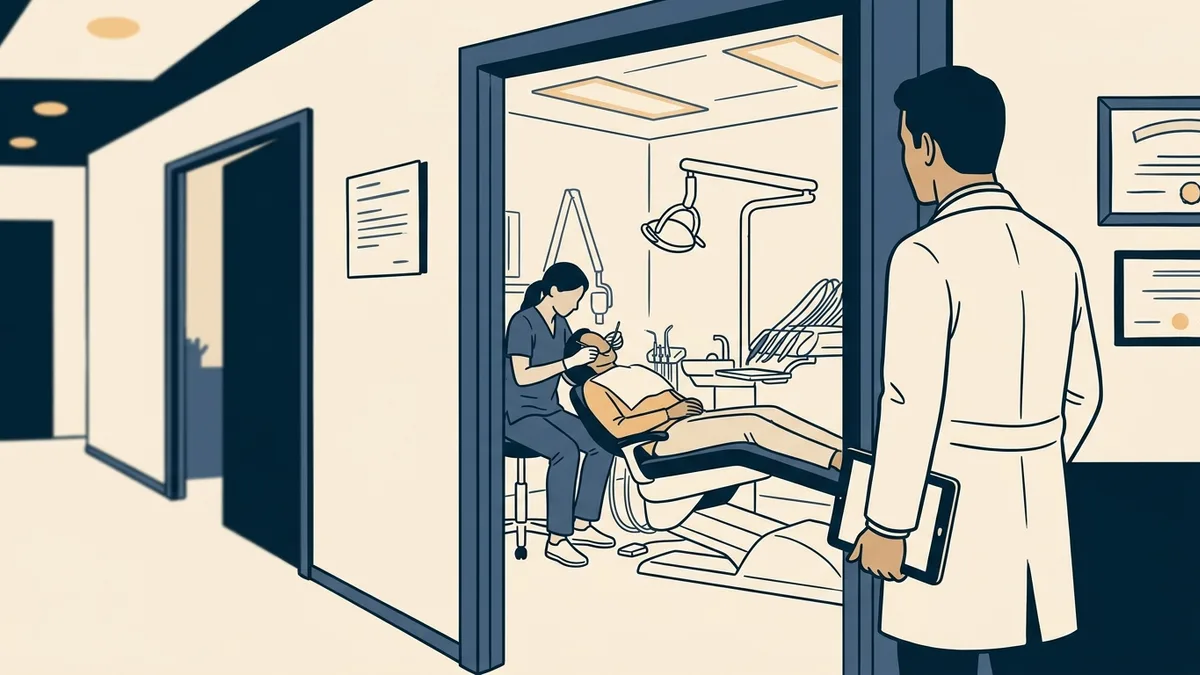
Supervision words like direct, indirect and general have no single national meaning. Each state defines them in its practice act. Florida's general supervision needs only the dentist's authorization, Virginia's requires that the dentist evaluated the patient, and New York requires personal supervision for hygienist local anesthesia. Read the new state's statute before your first day.
When a hygienist moves, the license application gets the attention. The supervision rules get discovered on the first day of work. A procedure you performed while the dentist was at a hospital meeting may require the dentist on the premises in your new state, or in the room, or may be allowed only in a public health setting. Employers can get this wrong too, and the consequences land on both licenses.
We do not generalize about what hygienists may do in a state, because the answer is in the statute and rules, procedure by procedure. What we can do is show how differently states define the same words.
Where do the standard supervision terms come from?
The American Dental Association defines five supervision levels for allied dental personnel in its Comprehensive Policy Statement on Allied Dental Personnel, as reproduced in the Dental Assisting National Board's state charts: personal, direct, indirect, general and public health supervision. Under the ADA's definition of general supervision, a dentist "is not required to be in the dental office or treatment facility when procedures are provided, but has personally diagnosed and treatment planned the condition to be treated, has personally authorized the procedures, and will evaluate the performance" of the allied personnel.
DANB adds the caveat that matters: these definitions "have not been uniformly adopted by the dental boards of every U.S. state or district." The ADA policy governs the ADA's own activities. State law governs your license.
How does Florida define supervision?
Florida's dental practice act defines three levels (Fla. Stat. § 466.003):
- Direct supervision: "a dentist diagnoses the condition to be treated, a dentist authorizes the procedure to be performed, a dentist remains on the premises while the procedures are performed, and a dentist approves the work performed before dismissal of the patient."
- Indirect supervision: "a dentist authorizes the procedure and a dentist is on the premises while the procedures are performed."
- General supervision: "a dentist authorizes the procedures which are being carried out but need not be present when the authorized procedures are being performed." The procedures "may also be performed at a place other than the dentist's usual place of practice."
Florida also lists tasks a licensed hygienist may perform in a defined "health access setting" (such as a Department of Health program, a federally qualified health center, a Head Start center or a school-based prevention program) "without the physical presence, prior examination, or authorization of a dentist," including charting, recording vital signs, applying fluoride and sealants, and removing calculus deposits (§ 466.024(2)). Local anesthesia, by contrast, requires direct supervision (§ 466.017(5)).
What does New York mean by personal supervision?
New York's dental hygiene definition says hygiene practice "must be done either under the supervision of a licensed dentist" or, for a hygienist working for a hospital, under a collaborative arrangement with a dentist who has a formal relationship with the same hospital (N.Y. Educ. Law § 6606). For local infiltration anesthesia and nitrous oxide, New York requires personal supervision, which it defines as the supervising dentist remaining in the dental office, personally authorizing and prescribing the anesthesia for the patient, and personally examining the patient before dismissal (§ 6605-b). New York also makes failing to provide that supervision professional misconduct for the dentist.
Does Virginia define general supervision differently?
Virginia's statute defines general supervision as meaning "that a dentist has evaluated the patient and prescribed authorized services to be provided by a dental hygienist; however, the dentist need not be present in the facility" (Va. Code § 54.1-2722(E)). Notice the difference from Florida: Virginia's definition requires that the dentist has evaluated the patient.
Virginia also has remote supervision, where the supervising dentist is "accessible and available for communication and consultation" but "may not have conducted an initial examination" and may not be present. A hygienist needs a qualifying continuing education course and at least two years and 2,500 hours of clinical experience to practice that way, and the statute limits remote supervision to listed settings. A hygienist under remote supervision may continue to treat a patient for 180 days before the dentist must examine the patient or refer the patient for an exam, and the statute bars local anesthetic and nitrous oxide under remote supervision. See Virginia dental licensing.
Which level does Arizona's statute default to?
Arizona's starting point is that a dental hygienist "shall practice under the general supervision of a dentist" licensed in Arizona, with listed exceptions (Ariz. Rev. Stat. § 32-1281(D)). The exceptions run both ways. Local anesthesia starts at direct supervision and can move to general supervision only for adult patients of record who meet conditions on recent examination and medical history; nitrous oxide stays under direct supervision. Arizona also recognizes practice under an affiliated practice relationship with a dentist (§ 32-1281(I)).
Is there a quick way to compare states before a move?
ADHA publishes a practice act overview of permitted functions and supervision levels by state (updated August 24, 2026). It codes each function by state with letters for direct, personal, indirect, general, collaborative practice and direct access supervision. It is a fast way to spot differences, such as which states list local anesthesia under direct supervision and which list general supervision. ADHA notes its charts are informational and not a legal opinion, and tells readers to verify with the state dental board. Use it as a map, then read the statute.
Should employers check anything before a hygienist starts?
- The supervision level for each procedure you perform most often, especially local anesthesia, nitrous oxide, radiographs and scaling and root planing.
- Whether the dentist must have examined the patient first, and how recently.
- Whether the state allows work outside the dental office, and under what agreement or permit.
- Any separate certificate a procedure needs. Our anesthesia permits guide covers the most common one.
Can we help with the license that comes first?
Yes. Our Dental Hygienist License service is $449 per state. We prepare the supporting documents, request verifications, write a question-by-question guide and track the board, and we point you to the practice act sections to read before your first day. You complete, sign and submit the application and pay the board. Moving into public health or collaborative practice? Read our public health hygienist permits post.
Common questions
- Is general supervision the same in every state?
- No. Florida defines it as the dentist authorizing the procedure without needing to be present. Virginia's definition also requires that the dentist has evaluated the patient. The ADA has model definitions, but states have not uniformly adopted them.
- Where can I compare supervision rules across states?
- ADHA publishes a practice act overview that codes supervision levels for common functions by state. ADHA says it is informational only, so confirm each item in the state's statute or rules.
- Does a hygienist need the dentist in the room to give local anesthesia?
- It depends on the state. New York requires personal supervision, with the dentist in the office and examining the patient before dismissal. Florida requires direct supervision. Arizona allows general supervision for certain adult patients of record.
- Can a hygienist treat patients without a dentist present?
- Some states allow it in defined settings or under a permit or agreement. Florida lists tasks hygienists may perform in health access settings, and Virginia allows remote supervision in listed settings. Each state's statute sets the limits.
Need Help with Your Application?
We prepare the dental licensing process end-to-end — eligibility screening, documents, board follow-ups, and tracking.