
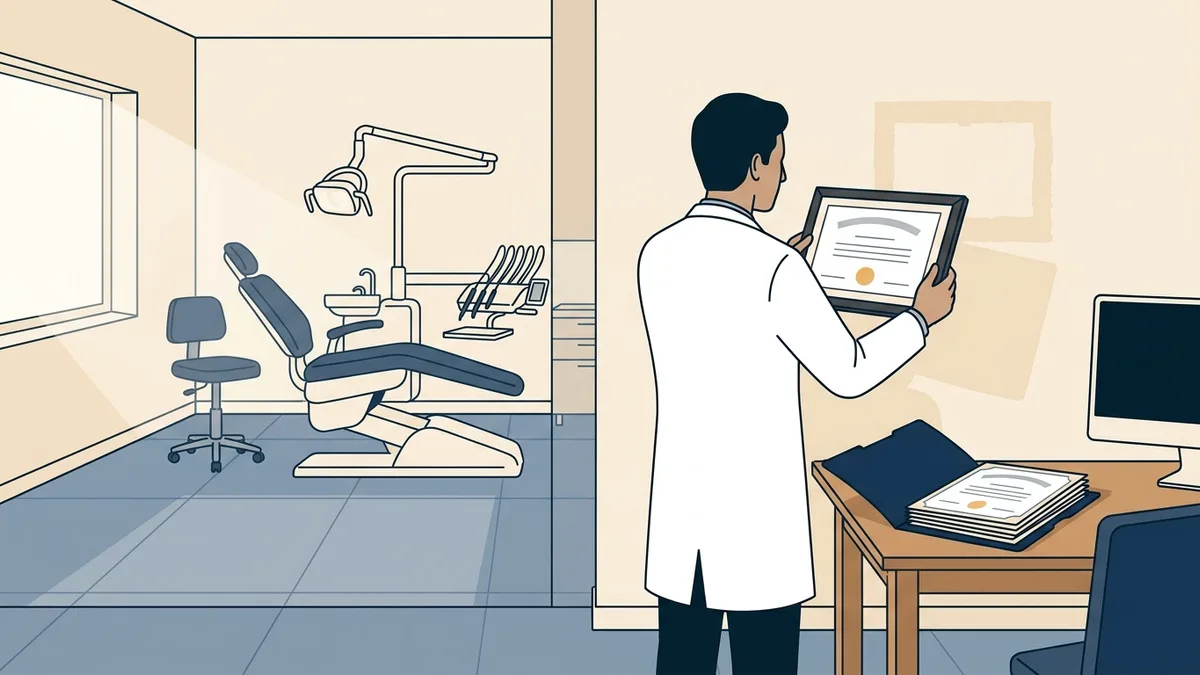
Reinstating a lapsed dental license depends on the state and how long it lapsed. Arizona allows reinstatement within 24 months with the renewal fee and a $100 penalty, then requires a new application. Illinois charges $50 plus all lapsed renewal fees. New York requires a full triennial period of continuing education before reactivating an inactive registration.
Dentists and hygienists who hold licenses in more than one state often let one lapse: after a move, after leaving a DSO, while on a long leave, or in semi-retirement. Months or years later, a job or a locum opportunity in that state makes the old license valuable again. Whether you can simply pay and reactivate, or have to apply from scratch, depends on the state's rules and on what happened to the license while you were away.
Is the license lapsed, inactive or retired?
The status matters more than the time. States commonly distinguish:
- Lapsed or expired: you did not renew, and the license no longer authorizes practice until it is restored.
- Inactive: you told the board you are not practicing there, often with reduced or suspended continuing education duties.
- Retired or disabled status: some states, such as Arizona, offer a reduced renewal fee for licensees who are fully retired or permanently disabled, with conditions (Ariz. Rev. Stat. § 32-1236(G)-(H)).
- Disciplined: suspended, revoked or surrendered licenses follow a separate process set by the board's order.
Look up your status on the board's license verification page before you do anything else.
How do Arizona and Illinois handle a lapsed license?
Arizona
Arizona dental licenses renew every three years. An expired license "may be reinstated by submitting a complete renewal application within the twenty-four-month period immediately following the expiration of the license with payment of the renewal fee and a $100 penalty." Reinstatement runs from the date of application and covers only the rest of the three-year period. After 24 months, the statute says you "must reapply for licensure" (A.R.S. § 32-1236(D)). Renewal also requires an affidavit that you meet the board's continuing education rules.
Illinois
Illinois sets a fee for restoring a license "other than from inactive status" of $50 plus payment of all lapsed renewal fees (68 Ill. Admin. Code § 1220.415). A dentist's renewal is $300 per cycle, so a license lapsed through more than one cycle costs more to restore. Ask the department what else it needs for your length of lapse.
What does New York require to reactivate?
New York separates the license from the registration, which renews every three years. A licensee who registered as inactive must complete continuing education before reactivating, and NYSED's Q&A sets out how much counts:
- You must complete the amount required for a normal three-year registration period: 60 hours for dentists and 24 for hygienists.
- If your registration was inactive because you were practicing in another jurisdiction, you can count credits earned up to 36 months before the month you reactivate.
- If you were not practicing at all, you can count only credits earned up to 12 months before reactivating.
For hygienists, the statute exempts a licensee not practicing from continuing education upon filing a statement, but requires notice to the department before returning to practice (N.Y. Educ. Law § 6609-a). NYSED may also issue a conditional registration to a licensee who falls short on continuing education and agrees to make it up.
What about California?
California's fee rule charges a delinquency fee for late license renewal in the amount set by Bus. & Prof. Code § 1724(f), and its sedation permits renew every two years on the last day of your birth month, with sedation-specific continuing education from the second renewal (Dental Board of California). Confirm the delinquency amount and any cutoff for renewal with the board before assuming a late renewal is available.
Why do reinstatements stall?
- Continuing education that does not count. New York's look-back windows, and course-type rules in other states, mean hours you have may not qualify.
- Practice gaps. A board may ask what you did while the license was lapsed, and long absences can bring added conditions.
- Practicing in the meantime. Any work in the state after expiration is a separate problem to disclose.
- Old permits. Sedation and other permits usually lapse with the license or on their own cycle and need their own reinstatement. See our sedation permits guide.
- Waiting past the window. In Arizona, the difference between month 23 and month 25 is a renewal versus a new application.
When is a new application the better path?
If the reinstatement window has closed, or the board would require you to meet current initial licensure standards anyway, a fresh application by credentials may be cleaner. Our licensure by credentials guide covers that route.
How do we help with reinstatement?
A reinstatement is usually prepared as a Full State Dental License Application ($899) or, for simpler late renewals, under our Annual Renewal & CE Compliance service ($299 per license, per year), which also tracks continuing education so the license does not lapse again. We confirm your status and the state's path, audit your continuing education against the look-back rules and assemble the documents. You complete, sign and submit the application and pay the board. Our renewal calendar post explains how to keep several licenses current.
Common questions
- Can I reinstate an expired Arizona dental license?
- Within 24 months of expiration, by submitting a complete renewal application with the renewal fee and a $100 penalty. After 24 months, Arizona's statute requires you to reapply for licensure.
- What does New York require to reactivate a dental registration?
- The continuing education for a normal three-year period: 60 hours for dentists, 24 for hygienists. If you were practicing elsewhere, credits from the past 36 months count; if not, only the past 12 months.
- How much does it cost to restore an Illinois dental license?
- Illinois charges $50 plus all lapsed renewal fees to restore a license other than from inactive status. Confirm any other requirements with IDFPR.
- Does my sedation permit come back with my license?
- Not necessarily. Permits often have their own renewal cycle and requirements, so check the permit's status separately.
Need Help with Your Application?
We prepare the dental licensing process end-to-end — eligibility screening, documents, board follow-ups, and tracking.