
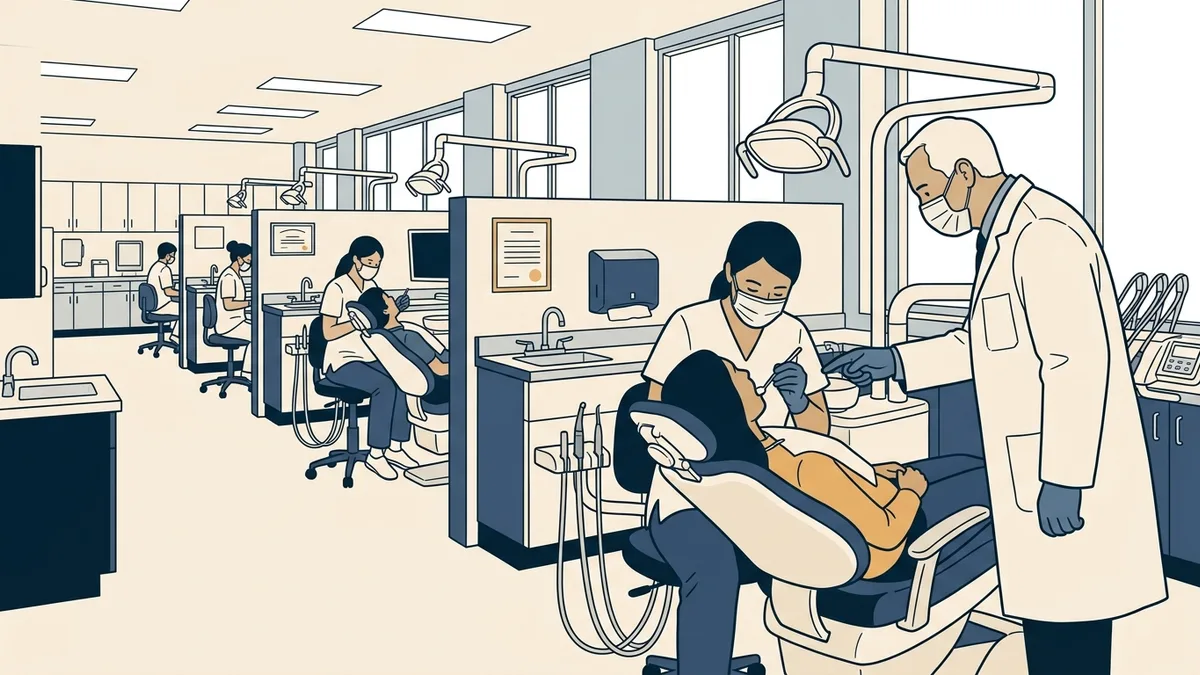
Several states license dental school faculty with a credential limited to the school. New York's restricted faculty license requires full-time employment, two years of practice in the last five and an advanced program, and costs $645. California's Special Permit costs $1,000, and Florida's teaching permit requires its Laws and Rules exam. None authorizes private practice.
A dentist who joins a dental school faculty in a new state often does not need, and sometimes cannot get quickly, a full license. Many states offer a faculty license or permit that authorizes practice only at the school and its affiliated clinics. These credentials are faster or more accessible for academic hires, including some dentists educated outside the United States, but they come with limits that matter for anyone who also wants a private practice or a faculty practice income.
How does New York's restricted dental faculty license work?
New York may issue a restricted dental faculty license to a full-time faculty member at an approved New York dental school (N.Y. Educ. Law § 6604-b). Practice is limited to the school's facilities and clinics, or facilities with formal affiliation agreements, and the license "does not authorize the holder to engage in the private practice of dentistry at any other site." NYSED lists these requirements:
- at least six academic years of pre-professional and professional education, including at least four years of dental education leading to a degree recognized where the school is located;
- at least two years of satisfactory practice as a dentist within the last five years, verified by a licensed dentist in good standing;
- completion of an accredited advanced education program in general dentistry or a specialty;
- full-time employment, defined as at least four full working days a week in teaching, patient care, research or administration, confirmed by the dean at application and every year after;
- child abuse reporting and infection control training.
The fee for the license and first registration is $645. If full-time employment ends, the license and registration are no longer valid, and both the faculty member and the dean must notify the Department within thirty days.
New York has two related routes. A limited permit for instructing in dentistry lets an unlicensed dentist employed by a registered dental or hygiene school instruct and supervise clinical dentistry on school premises; it lasts one year and costs $105 (§ 6605). And the statute exempts a dentist licensed elsewhere who is a full-time faculty member at the rank of assistant professor or higher from licensure for research and clinical demonstrations on the school's premises, under a licensed dentist's supervision, with no fee charged (§ 6610).
What is California's Special Permit?
The Dental Board of California issues a Special Permit to a full-time faculty member contracted at a California dental school as a professor, associate professor or assistant professor. The board says the permit holder "can practice 1 day per week at the dental school's faculty practice," full-time means 4 days a week, and a holder may move to a part-time contract after seven years with notice to the board.
There are two qualification methods. Under Bus. & Prof. Code § 1640, the applicant shows a pending full-time contract, graduation from a board-approved dental college or completion of an accredited advanced education program, diplomate status or eligibility for a specialty board exam (or completion of an advanced program in a discipline), and a passing score on the California Law and Ethics exam. Under § 1640.3, the board may issue a permit to a dentist who does not meet § 1640 if the dean of the dental school verifies in writing that adding the dentist will benefit the students and program, among other conditions. The application fee is $1,000 and renewal is $125 (16 CCR § 1021).
Do Florida and Illinois license faculty too?
Florida issues a dental teaching permit to a full-time dental instructor who practices only at the teaching facilities of the accredited dental program (Fla. Stat. § 466.002; Fla. Admin. Code R. 64B5-7.005, as summarized by the Board of Dentistry). The applicant needs a dental degree and one of four qualifications, which include eligibility for the Florida licensure exam without three failures, completion of a CODA-accredited post-doctoral program of at least two years, or a foreign dental degree with agreement to practice only under the general supervision of a Florida-licensed dentist. The dean submits the application with a cover letter on teaching experience and any malpractice claims or disciplinary actions. The applicant must pass the Florida Laws and Rules exam, and must hold BLS-level CPR or obtain it within 60 days.
Illinois charges $250 to apply for a restricted faculty license and $150 to renew it (68 Ill. Admin. Code § 1220.415).
Are there trade-offs to a faculty license?
- Location limits. Practice is tied to the school and approved affiliates. Private practice elsewhere needs a full license.
- Employment dependence. In New York the license stops being valid when full-time employment ends. Plan the full license early if you might leave.
- Annual paperwork. New York wants the dean's employment verification every year.
- Separate permits. Sedation and specialty permits still follow their own rules; see our sedation permits guide.
- No compact help. The dental compact is not issuing privileges, and its FAQ says dentists without a CODA-accredited predoctoral DDS or DMD, such as foreign-trained dentists, are not eligible.
Can we help faculty hires and dental schools?
Our Faculty, Temporary or Volunteer License service is $299 per state. We confirm which faculty credential fits the appointment, assemble the education and experience verifications, coordinate the dean's forms and employment letters, and track the file. The faculty member completes, signs and submits the application and takes any law exam; the dean signs the school's forms. For dentists educated abroad, see licensure paths for foreign-trained dentists.
Common questions
- Can a faculty license holder have a private practice?
- Generally no. New York's restricted faculty license expressly excludes private practice at any other site, and Florida's teaching permit limits practice to the school's teaching facilities. California's Special Permit allows practice at the school's faculty practice one day a week.
- What happens to a New York faculty license if I leave the school?
- If you stop being a full-time faculty member at an approved New York dental school, the license and registration are no longer valid. You and the dean must notify the Department within thirty days.
- Do foreign-trained dentists qualify for faculty licenses?
- Some routes allow it. New York accepts dental education recognized where the school is located, and Florida's teaching permit has an option for foreign graduates who practice only under a Florida dentist's general supervision. Each route has other conditions.
- How much does a California Special Permit cost?
- The application fee is $1,000 and renewal is $125, under 16 CCR § 1021.
Need Help with Your Application?
We prepare the dental licensing process end-to-end — eligibility screening, documents, board follow-ups, and tracking.